Most independent workshops already service hybrids, whether they planned to or not. The question isn't whether to touch them. It's which jobs you can do safely with the training you have now, which need more, and how to price the extra time. This guide splits hybrid and EV work into three levels, covers the training on offer in New Zealand and the high-voltage safety basics, and gives a way to price it that doesn't rely on guesswork.
Updated 18 November 2026. This is a practical guide, not a safety procedure. Always follow the manufacturer's service information and your own written procedures. If you're still deciding whether EV work is worth the investment, start with our EV servicing business case.
What counts as high voltage?
NZQA's unit standard for preparing to work safely on hybrid and battery electric vehicles defines high voltage as anything above 60 V. Hybrid and EV traction systems run well above that. The orange cables and everything they connect to are the high-voltage system. The 12 V battery and its circuits are not.
That line is the useful one for planning work: does this job mean working on or near the high-voltage system, or not?
Which hybrid and EV jobs can an independent workshop do?
| Level | Typical jobs | What you need |
|---|---|---|
| 1. Outside the high-voltage system | Oil and filter on hybrids, tyres and rotations, wipers, cabin filters, 12 V battery, suspension and steering, brake pads (to the manufacturer's procedure), WoF pre-checks | Awareness training for anyone working on or around the vehicle; manufacturer service data |
| 2. Near the high-voltage system | Jobs where orange cables or high-voltage parts are in the way, inverter or battery coolant service, AC compressor work on electric compressors | Formal training to isolate the system and prove it's dead; insulated tools and gloves; a written isolation procedure |
| 3. On the high-voltage system | Battery modules, inverters, motors, high-voltage cable repairs, diagnosis of hybrid system faults | Level 5 EV training, the manufacturer's diagnostic tools and data, and a clear decision about what you sublet |
Level 1 is where most of the volume is. A hybrid that comes in for a service, brakes or a WoF pre-check is ordinary work with a few extra checks.
Hybrid and EV training in New Zealand
| Training | Level | For | Detail |
|---|---|---|---|
| NZQA unit 31806: prepare to work safely on hybrid and battery EV high-voltage systems | Level 4, 2 credits | New entrants to EV work | Disable the high-voltage system and measure critical points to prove it's de-energised. Prerequisite: unit 30569 (knowledge of hybrid and battery EVs) |
| MITO New Zealand Certificate in Electric Vehicle Automotive Engineering | Level 5, 70 credits | Qualified technicians with a Level 4 automotive qualification | 11 months; $1,118 excluding GST |
Two points that catch people out. First, the unit standard itself says competency doesn't entitle anyone to do prescribed electrical work. That work needs a person registered and licensed under the Electricity Act 1992. Second, the Health and Safety at Work Act 2015 applies to all of it: the business has to manage the risk, not just the technician. Check MITO's programme finder for what's running in your region.
High-voltage safety basics for the workshop
- Write the procedure down, per make if you see a lot of one brand: how to isolate, how long to wait, where to measure.
- Isolate and prove it. Disable the system the way the manufacturer specifies, then measure to confirm it's de-energised. That's exactly what unit 31806 assesses.
- Secure it. Keys and fobs away from the car, the service plug in your pocket, a sign on the vehicle so nobody re-energises it.
- Right gear. Insulated gloves rated for the voltage and checked before each use, insulated tools, and a clear area around the car.
- Only trained people on level 2 and 3 jobs. Everyone else in the workshop needs to know what the signs and the orange cables mean.
- Record it. Who isolated it, when, the reading, and who re-energised it. A sign-off on the job is your evidence if something goes wrong later.
How to price hybrid and EV work
There's no published NZ benchmark for hybrid labour, so price it from your own time:
- Start from the manufacturer's labour time, as you would for any job.
- Add isolation as its own line. If a level 2 job means isolating and re-energising the system, that time is real and the customer can see why it's there.
- Charge diagnosis separately for hybrid system faults, and quote the repair after you've found it.
- Don't discount level 1 work. A hybrid oil service is still an oil service. The extra checks are part of a proper service.
- Clock the real time on the first few of each job type, then set a fixed price once you know it.
- Decide what you sublet, and put a margin on sublet work like any other.
For your base hourly rate, see our NZ labour rates guide.
The WoF angle
Since 1 November 2026, WoF and CoF A inspections check for warning or malfunction lights on Automatic Emergency Braking and Lane Keep Assist systems, where fitted. Many newer hybrids have both. Catching a warning light at a service, before the WoF, is easy work for you and saves the customer a fail. See our ADAS WoF checks guide.
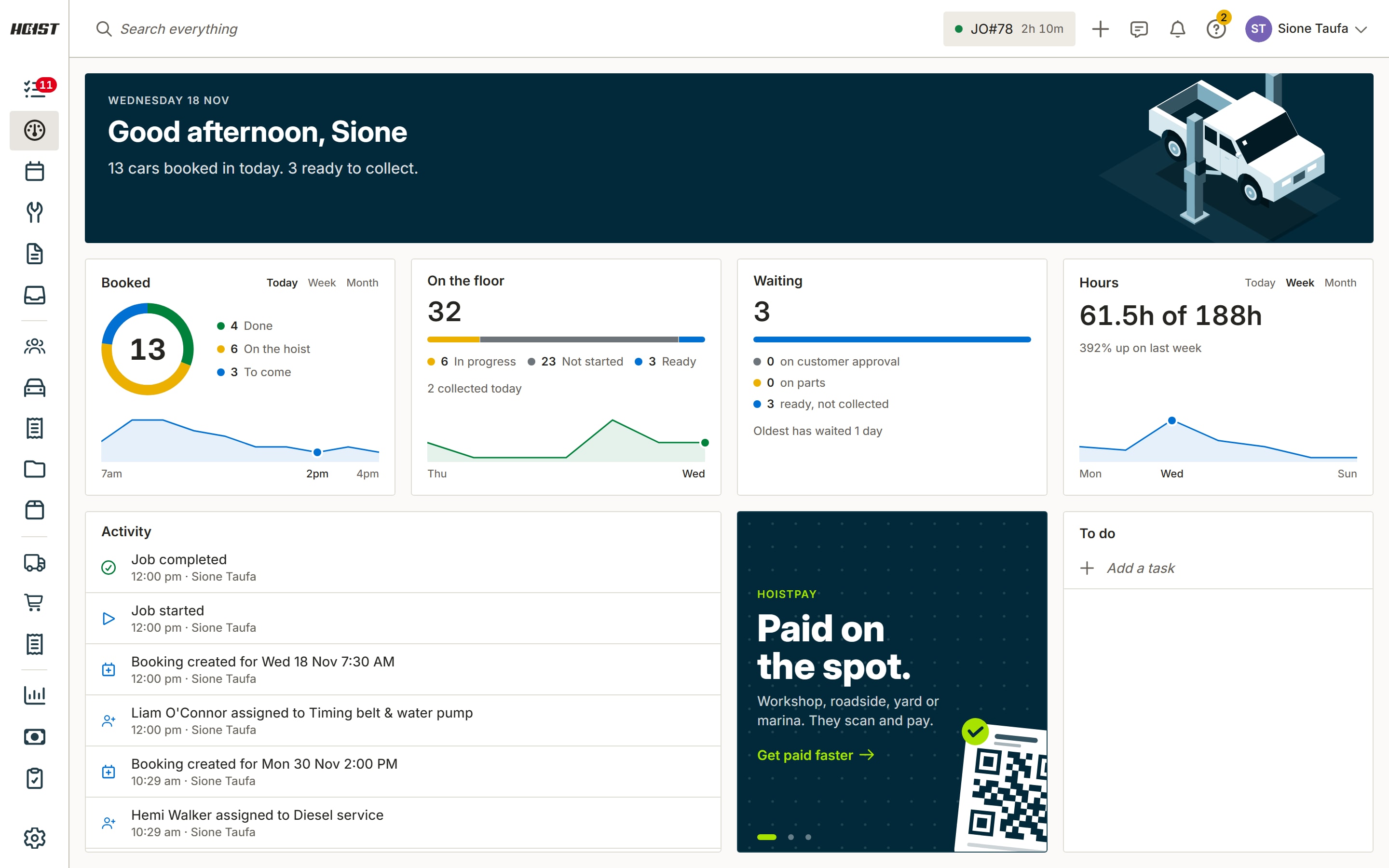
Running hybrid jobs in Hoist
- Job templates with parts and labour for your hybrid service, at a fixed price once you know your time.
- A hybrid inspection template with the high-voltage isolation sign-off as a required check and a photo of the meter reading. See digital inspections.
- Job clocking on the mobile app, so you know what hybrid jobs really take before you set prices.
Price hybrid work from real times
Job templates, inspection sign-offs and clocking on one plan. $140 + GST a month, 3 users included. Free trial, no card needed.
Start Free TrialSources
- NZQA, Unit standard 31806: Prepare to work safely on or around hybrid electric vehicle and battery electric vehicle or machine high voltage systems (60 V definition, performance criteria, prescribed electrical work note, HSWA 2015)
- MITO, Electric Vehicle (Level 5) (credits, duration, fee, entry requirements)
- New Zealand Legislation, Health and Safety at Work Act 2015
- NZTA, Changes to light vehicle inspections from 1 November 2026