"We were flat out all week" and "we billed 60 hours" can both be true of the same four-person workshop. Technician efficiency and utilisation are the two numbers that explain the gap. Utilisation tells you how much of the paid day went on customer jobs. Efficiency tells you how much you sold for the time spent on those jobs. This guide gives the formulas, a worked example, and how to get the numbers from timesheets or job clocking.
Updated 18 November 2026. There's no published New Zealand benchmark for these figures, so this page doesn't invent one. Measure your own baseline and improve on it.
Efficiency vs utilisation: the formulas
| Measure | Formula | Answers |
|---|---|---|
| Utilisation | Hours clocked on customer jobs ÷ hours attended × 100 | How much of the paid day went on jobs? |
| Efficiency | Hours sold ÷ hours clocked on customer jobs × 100 | Did the work take less or more time than you charged for? |
| Productivity (overall) | Hours sold ÷ hours attended × 100 | How much of the paid day did you actually bill? |
Productivity is utilisation multiplied by efficiency. That's why you need both: a technician can be busy all day (high utilisation) on jobs that take twice what you charged (low efficiency), and the overall figure looks the same as an idle technician who works fast.
Get the definitions right first
- Hours attended: the hours you pay the technician to be at work, less unpaid breaks. Leave and public holidays come out.
- Hours on jobs: time clocked against a customer job. Cleaning, parts runs, training, waiting for a car and in-house work are not job time.
- Hours sold: the labour hours on the invoice. For a fixed-price job, use the labour hours you built into the price. A warranty comeback sells zero hours.
Decide these once, write them down, and don't change them month to month. A consistent definition matters more than a perfect one.
Worked example
| Tech A | Tech B | |
|---|---|---|
| Hours attended in the week | 40 | 40 |
| Hours clocked on jobs | 34 | 26 |
| Hours sold | 30 | 31 |
| Utilisation | 85% | 65% |
| Efficiency | 88% | 119% |
| Productivity | 75% | 78% |
Similar overall result, opposite problems. Tech A is on the tools all day but jobs run over what's charged: look at quoting, job prices, diagnosis that isn't charged, or comebacks. Tech B finishes jobs well inside the sold time but spends a third of the week off the tools: look at scheduling gaps, waiting for parts or approvals, and how much admin they're doing.
Efficiency over 100% is normal when you sell fixed-price or menu jobs and the technician knows them well. It isn't a reason to cut the price.
Why it matters in NZ right now
Finding technicians is hard and slow. MTA has called the skills shortage "the number one issue keeping MTA members awake at night", and its October 2022 member survey found that when members recruited locally, more than 80% of the time they got no applicants or clearly unsuitable ones. Motor mechanics are on Immigration New Zealand's list for the Skilled Migrant Category trades and technician pathway. Tahatū counts about 11,000 automotive technicians at the 2023 Census.
When you can't easily add a person, the cheapest capacity is the hours already on the payroll. Worked out on your own rate, one extra sold hour per technician per day at $120 an hour is $600 a week each. That's usually hiding in utilisation: the 20 minutes between jobs, the parts run, the car waiting for approval.
How to measure it from timesheets or job clocking
- Record attendance: clock on and off for the day, with breaks.
- Clock onto each job: start when work on the car starts, stop when it stops. One job at a time.
- Clock non-job time to a task: cleaning, parts run, training, waiting. That's how you see where utilisation goes.
- Take sold hours from invoices, not from the job card estimate.
- Review weekly, by technician, then as a workshop. Daily numbers swing too much to mean anything.
- Look at jobs, not just people. If one job type always runs over, fix its price or labour time, not the technician.
Paper timesheets work if they're filled in at the time, not at 5 pm from memory. Most workshops that try it on paper find the job times come out suspiciously round.
What moves each number
| Low utilisation: causes | Low efficiency: causes |
|---|---|
| Gaps in the schedule, cars not here yet | Labour times under-quoted |
| Waiting for parts or customer approval | Diagnosis done but not charged |
| Parts runs and admin done by technicians | Comebacks and rework |
| One diagnostic tool shared by everyone | Unfamiliar makes or systems |
For utilisation, book to capacity per technician, have parts on the shelf before the car arrives, and get approvals from a link instead of phone tag. For efficiency, charge diagnosis, set labour times from real clocked jobs, and track comebacks. Our workshop efficiency guide goes deeper on scheduling and bottlenecks, and workshop KPIs covers the financial numbers around these.
Using the numbers fairly
These figures are for finding problems in the system, not for punishing people. Share them with the team, explain the definitions, and pair them with something the technician controls. If you pay a productivity bonus, base it on sold hours, set it in the employment agreement, and get advice first. Pay rates are in our mechanic wages guide.
Measuring it in Hoist
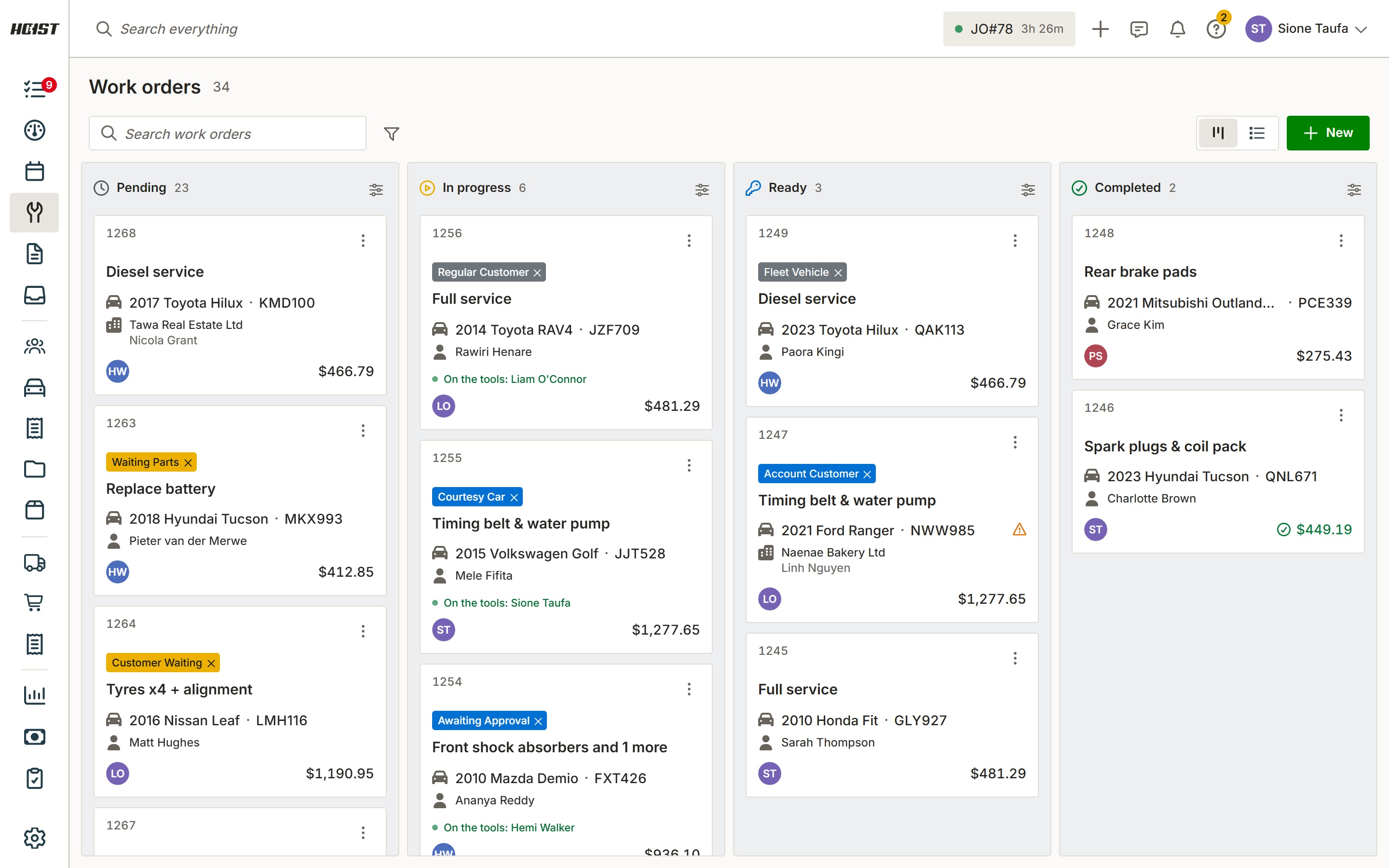
- Job clocking: technicians start, pause and resume a job on the Hoist mobile app or a shared PC. Starting another job ends the last one.
- Tasks and breaks: "What's next?" switches a technician onto a task or a break, so non-job time is recorded too (with Run pay from Hoist on).
- Timesheets, Performance tab: shows on the clock, on jobs and charged figures per person. Those are the three numbers in the formulas above.
- Reports: Job time vs sold shows which jobs ran over their sold labour. Technician performance shows how much of each day was on jobs.
See where the hours go
Job clocking, timesheets and the performance figures on one plan. $140 + GST a month, 3 users included. Free trial, no card needed.
Start Free TrialSources
- MTA, Skilled motor mechanics added to Green List (skills shortage comments and recruitment survey)
- Immigration New Zealand, Eligible occupations for the SMC Trades and Technician pathway (Motor Mechanic 321211)
- Tahatū, Automotive technician (number employed, 2023 Census)