Below is a complete job card template you can copy, print, or download, every field a NZ workshop job card should have, including rego, WOF due date, customer authorisation, and GST-inclusive totals. Use it as-is or adapt it to how your workshop runs.
Why the job card matters more than you think
A job card is not paperwork for the sake of it. It does three jobs at once:
- It tells the tech what to do. Reported fault, work requested, anything the customer mentioned at drop-off.
- It captures what you’re owed. Every part fitted and every hour on the tools. If it’s not on the card, it doesn’t get invoiced, and unbilled work is the quietest leak in most workshops.
- It protects you legally. Under New Zealand consumer law, a repairer needs the customer’s authorisation before doing work beyond the agreed scope, Consumer Protection’s guidance is that a customer may not have to pay for work they never agreed to. If you find a stuffed CV boot mid-service and replace it without a yes from the customer, they can push back on that line, and without a signed authorisation and a record of the extra-work approval, it’s your word against theirs. A job card with an authorisation signature, a written estimate, and a note of when and how extra work was approved is your evidence.
The Consumer Guarantees Act separately requires work to be done with reasonable care and skill, and at a reasonable price if none was agreed. A dated, itemised job card, odometer reading, parts, hours, is how you show exactly what was done and what it cost. Workshops lose disputes on missing records far more often than on bad workmanship.
The template
One card per vehicle, per visit. Here’s every field and why it’s there.
Job details
| Field | Notes |
|---|---|
| Job card number | Sequential. Never reuse a number. |
| Date in / promised date | When the vehicle arrived and when you’ve told the customer it’ll be ready. |
| Assigned technician | Who’s on the job. Matters when there’s a comeback. |
Customer details
| Field | Notes |
|---|---|
| Name | Person authorising the work, not always the driver. |
| Phone (mobile) | You’ll need it mid-job for approvals. Get the one they answer. |
| For the invoice and service reminders. | |
| Account / fleet reference | If they’re a trade or fleet customer. |
Vehicle details
| Field | Notes |
|---|---|
| Rego | Plate number. |
| Make, model, year | |
| VIN | The rego can change; the VIN can’t. Ties history to the vehicle. |
| Odometer reading (in) | Non-negotiable, see common mistakes below. |
| WOF due date | Even if they’re not in for a WOF. It’s a free prompt for the next booking, and from 1 November 2026 newer light vehicles (aged 4 to 14 years, first registered on or after 1 November 2019) move to a two-yearly WOF, so the gap between visits gets longer and the date on the card matters more, not less. |
| Fuel level (optional) | Cheap insurance against "the tank was full when I dropped it off." |
Reported fault
What the customer told you, in their words. "Grinding noise from the front when braking, worse when cold." Don’t translate it into your diagnosis yet, the card should show what was reported versus what was found.
Work requested / estimate
The agreed scope and the estimated price before the vehicle goes on the hoist. This is the line the CGA cares about: what did the customer actually say yes to?
Parts used
| Column | Notes |
|---|---|
| Part number | |
| Description | |
| Qty | |
| Unit cost | What you paid. |
| Sell price | What you’re charging, markup included. Price every part at the time you fit it. |
| Line total |
Labour
| Column | Notes |
|---|---|
| Description of work | Per task, not one vague "repairs" line. |
| Hours | Actual time on the tools. |
| Rate (NZ$/hr) | Your charge-out rate. |
| Line total |
Extra work authorisation
The field most templates skip and the one that saves you. When you find something mid-job:
- What was found
- Quoted price for the extra work
- Customer approval: who approved, how (phone / text / in person), when (date and time), taken by (which staff member)
A text message trail is fine. No record at all is not.
Technician notes
What was found, what was done, what was measured (pad thickness, tread depth, battery test result), and anything the customer should watch, "rear pads at 30%, will need doing within 10,000 km." These notes become your service history and your next booking.
Totals
| Line | Notes |
|---|---|
| Parts subtotal | |
| Labour subtotal | |
| Sundries / environmental fee | If you charge one, show it, don’t bury it. |
| GST (15%) | |
| Total (GST inclusive) | The number the customer pays. |
Quote GST-inclusive to private customers, that’s the price they compare. Example: 2.5 hours at NZ$110/hr is NZ$275, plus a NZ$96.20 set of pads, gives NZ$371.20 excl. GST, NZ$426.88 including GST. That last figure is the one that belongs in the estimate conversation.
Sign-off
| Field | Notes |
|---|---|
| Authorisation signature + date | Customer signs the estimate/scope at drop-off. |
| Completion sign-off | Tech or workshop owner confirms the work is done and checked. |
How to fill it out
- Complete the vehicle section at drop-off, not later. Rego, VIN, odometer, WOF due, fuel level, two minutes while the customer is standing there.
- Write the reported fault in the customer’s words. It keeps the diagnosis honest and shows the scope you started from.
- Get the signature before the vehicle moves. An unsigned card is an unpriced favour waiting to be disputed.
- Price parts as you fit them. End-of-job pricing from memory is where margin goes missing.
- Record hours as you go, not reconstructed on Friday. Techs consistently under-remember their own time.
- Log every extra-work approval the moment you get it. Name, time, method. Thirty seconds now beats an argument at pick-up.
Common mistakes
- No odometer reading. Without it you can’t anchor service history, can’t defend a warranty claim, and can’t send an accurate next-service reminder. It’s the most skipped field and the most expensive one.
- No authorisation for extra work. The CGA problem above. "They said go ahead on the phone" with no note of who, when, or how is a weak position.
- Unpriced parts. A part written down without a sell price usually goes out the door at cost, or free. Every part line needs a price on it before the card is closed.
- One vague labour line. "Repairs: 4 hrs" invites a dispute. Itemised labour looks fairer to the customer and is easier to stand behind.
- The card never closes. Job’s done, car’s gone, card sits in a pile. Every open card is an invoice you haven’t sent.
When paper job cards start costing you
Paper cards work until they don’t, and the failure points are predictable:
- Cards go missing. Lost card, lost invoice. In our experience a paper workshop loses a handful a year and never knows which ones.
- Work doesn’t get billed. The part fitted in a hurry, the extra half hour, the sundries, if closing the card means deciphering handwriting three days later, lines get dropped.
- There’s no history. When a customer rings about the noise "you fixed last year," the answer is in a banker’s box, if it’s anywhere.
- The card can’t chase the next job. A WOF due date written on paper reminds nobody.
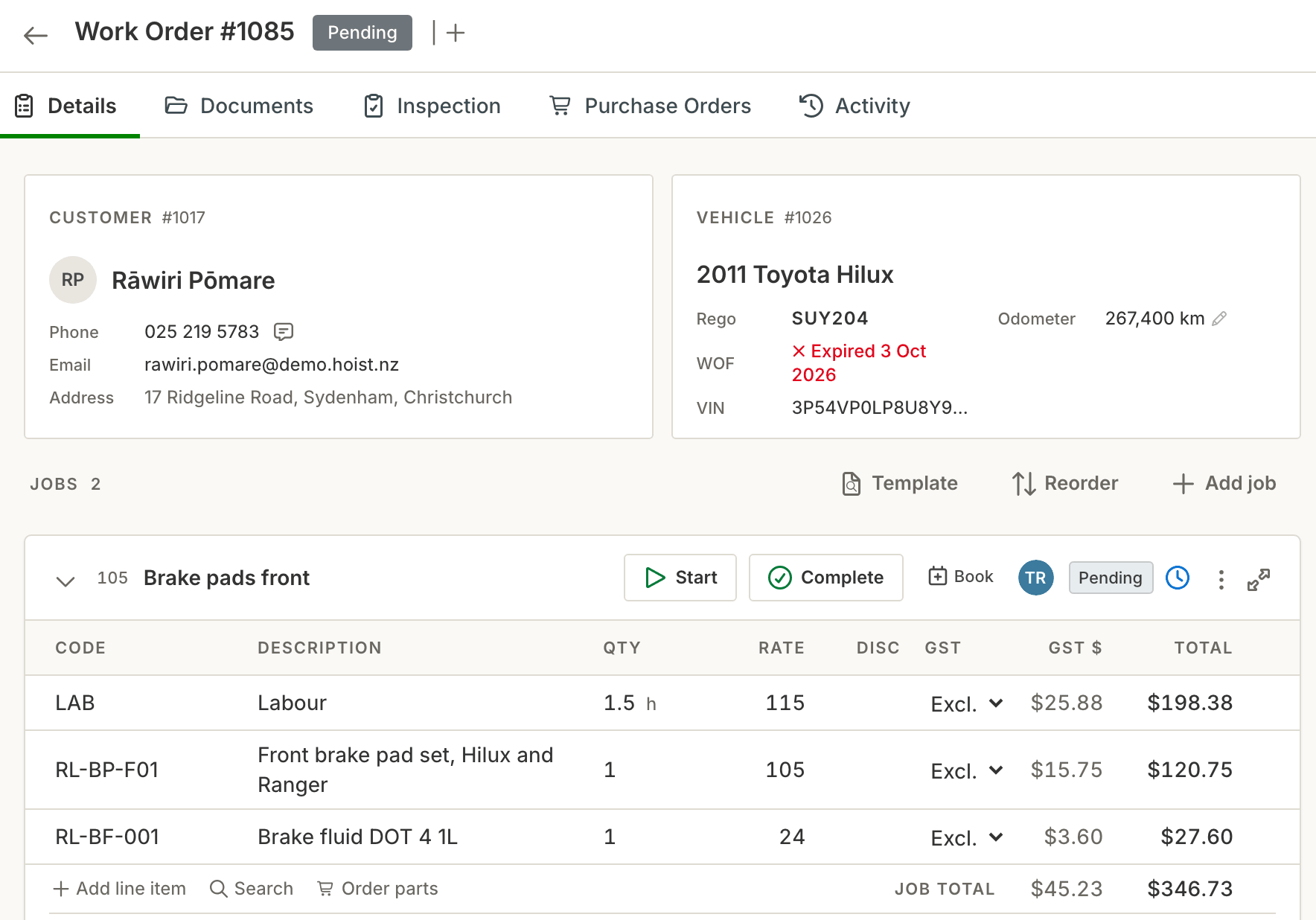
If that list sounds familiar, that’s the point where digital job cards pay for themselves. In Hoist, the job card is the same card as this template, entered once, it flows through to the invoice, the service history, and the WOF reminder without re-keying. Pricing is at hoist.nz/pricing, and you can start a free trial and run a real job through it this week, no card needed.
Until then: print the template, put a signature line on every card, and never skip the odometer.
Sources: Consumer Protection NZ: Fixing your car · Consumer Protection NZ: Consumer Guarantees Act · Consumer Protection NZ: Repairs