Here’s the maths that matters: from 1 November 2026, a customer’s 2021 Corolla that came in every 12 months will come in every 24. From late 2027, the same goes for their 2015 Hilux. And their 1998 ute, the one that used to show up every six months, drops to once a year.
For most NZ workshops, the WOF has quietly been the entire customer retention system. The sticker expires, the reminder goes out, the car comes in, and while it’s on the hoist you find the worn pads and the perished wiper blades. For a big chunk of the fleet, that loop is about to slow right down, and the workshops that treat this as a reminder-frequency problem instead of a retention problem are going to feel it.
This is the playbook for fixing it before November 2026, not after.
What’s actually changing
Quick recap, the full breakdown is in our explainer on the 2026 WOF changes:
- From 1 November 2026: light vehicles aged 4-14 years registered on or after 1 November 2019 move from annual to two-yearly WOFs. New vehicles get 4 years before their second WOF. Pre-2000 vehicles and motorcycles drop from six-monthly to annual.
- From 1 November 2027: two-yearly WOFs extend back to vehicles registered on or after 1 November 2013 (aged 4-14, motorcycles excluded).
- No change: vehicles registered between 2000 and October 2013 stay on annual WOFs.
So the visits don’t vanish evenly, they vanish from both ends of your book. Your newer-car customers halve their visits, your pre-2000 loyalists halve theirs, and the 2000s-era middle keeps turning up annually, same as now.
The counterweight: the MTA puts the current WOF fail rate at 41%. Cars aren’t getting healthier, many are just getting inspected less often. The work will still exist. The question is whether the customer thinks of you when it’s needed, without a WOF expiry forcing the issue.
The real problem: WOF was your recall system
If your reminder list is sorted by WOF expiry date, your marketing runs on a schedule NZTA sets, and NZTA just changed the schedule. Retention now has to run on something you control. Here are seven things that work.
1. Anchor reminders to service intervals, not WOF dates
The WOF date is the legal minimum, not the maintenance schedule. Oil doesn’t last 24 months. Neither do brake pads on a car doing school runs and a daily commute.
Switch your reminder anchor from "WOF due" to time- or kilometre-based service intervals: every 10,000-15,000 km or every 12 months, whichever comes first, per vehicle. A customer on two-yearly WOFs still needs one to two services in between, visits that used to piggyback on the WOF and now need their own trigger.
Practical version: at every job, record the odometer reading and set the next service due date before the invoice goes out. While you’re there, make sure the vehicle’s first-registration date is on file, because from November that date, not the age, decides which WOF schedule the car is on. If you know a customer does roughly 15,000 km a year, you know when to get in touch, regardless of what the sticker says.
2. Book the next visit before the car leaves
The cheapest retention tool in the industry is a sentence at handover: "I’ll pencil you in for a service in March, we’ll text you the week before to confirm."
Capture it at invoice time, while the customer is standing at the counter and the relationship is warm. A soft booking with a confirmation text later converts far better than a cold reminder to someone who hasn’t thought about you in 23 months. Dentists have run on this model for decades. There’s no reason a workshop can’t.
If a firm date feels pushy, book the reminder instead: "We’ll flag you in six months when the ute’s due." Either way, the next contact point exists before the car leaves the yard.
3. Chase the work that walked out the door
That 41% fail rate tells you something else: a lot of cars come through with problems. And every workshop has the other list, work you identified, quoted, and heard "not this time" about. Tyres at 2 mm. A weeping rocker cover gasket. Front pads at 30%.
Under annual WOFs, you’d catch that work next visit anyway. Under two-yearly WOFs, "next visit" might be 2028, and someone else’s problem by then.
So follow up deliberately:
- At 30 days: a short, personal message. "Hi Dave, when the Legacy was in we flagged the front tyres, happy to sort them whenever suits. Want me to hold a set?"
- At 90 days: one more touch, especially for safety items. Then leave it.
Two messages, sent from your workshop system, referencing the actual vehicle and the actual job. That’s not spam, that’s the follow-up most customers assume never happened because most workshops never do it.
4. Send texts, not just emails
If your reminders only go by email, a chunk of them die in a promotions tab. SMS gets read, usually within minutes, usually the same day.
The format that works is short and specific:
Hi Sarah, the Swift (KLM123) is due for a service. Book a time here: [link], or ring us. Cheers, Mike @ Apex Auto
Three rules: keep it under two sentences of substance, make it sound like a person rather than a platform, and include a booking link so the customer can act at 9pm from the couch. We’ve compared the channels properly in SMS vs email for workshop reminders: short version, use SMS for the action and email for the detail.
5. Keep history so reminders say something
"Your vehicle may be due for a service" is wallpaper. "Your Hilux is due for its cambelt, it was done at 105,000 km in 2021 and you’re coming up on 200,000" is a booking.
Specific reminders need complete vehicle history: every job, every part, every odometer reading, every declined item, in one place per vehicle. If your records live across an old PC, a diary, and a mate’s memory, you can’t write that second message, and with 24 months between visits, you won’t remember the details yourself either.
This is also what makes a lapsed customer feel like a regular. When someone rings after two years away and you can say "last time we did the front discs and flagged the battery," you’ve just proven why they shouldn’t ring around for quotes.
6. Be findable when they finally search
Longer gaps between visits mean more customers will simply forget who serviced their car last. When that happens, they do what everyone does: search "mechanic near me" and pick from the top results.
Two jobs here:
- Keep your Google Business Profile current: hours, photos, services, correct phone number. It’s the first thing a lapsed customer sees, and an out-of-date profile reads as a closed business.
- Ask for reviews at handover, every time. The workshop with 150 recent reviews wins the lapsed customer over the one with 12 from 2021, including customers who were technically yours first. Our Google reviews guide covers the mechanics.
Retention isn’t only about memory. It’s about being the obvious choice when memory fails.
7. Measure it, or you’re guessing
Two numbers, checked monthly:
- Retention rate: of the customers you saw in a given period, how many came back within the next 12-24 months? (As two-yearly WOFs kick in, measure over 24 months or the number will look worse than it is.)
- Visits per customer per year: total jobs divided by unique customers. This is the number the WOF changes directly attack, and the number tactics 1 to 4 defend.
Worked example, illustrative numbers, your mix will differ: 600 active vehicles averaging 1.8 visits a year is 1,080 jobs. If the WOF changes drag that to 1.3 visits and you do nothing, that’s 780 jobs, 300 gone. Claw back half a visit per customer with service-interval reminders and pre-booking, and you’re back to par. The tactics above aren’t nice-to-haves; they’re the difference between those two numbers.
If you can’t produce these figures from your current setup, that’s finding number one.
Where Hoist fits
Everything above can be done manually. Almost nobody does it manually for long, because chasing 600 vehicles across different service intervals, declined-work follow-ups, and booking confirmations is a full-time job on its own.
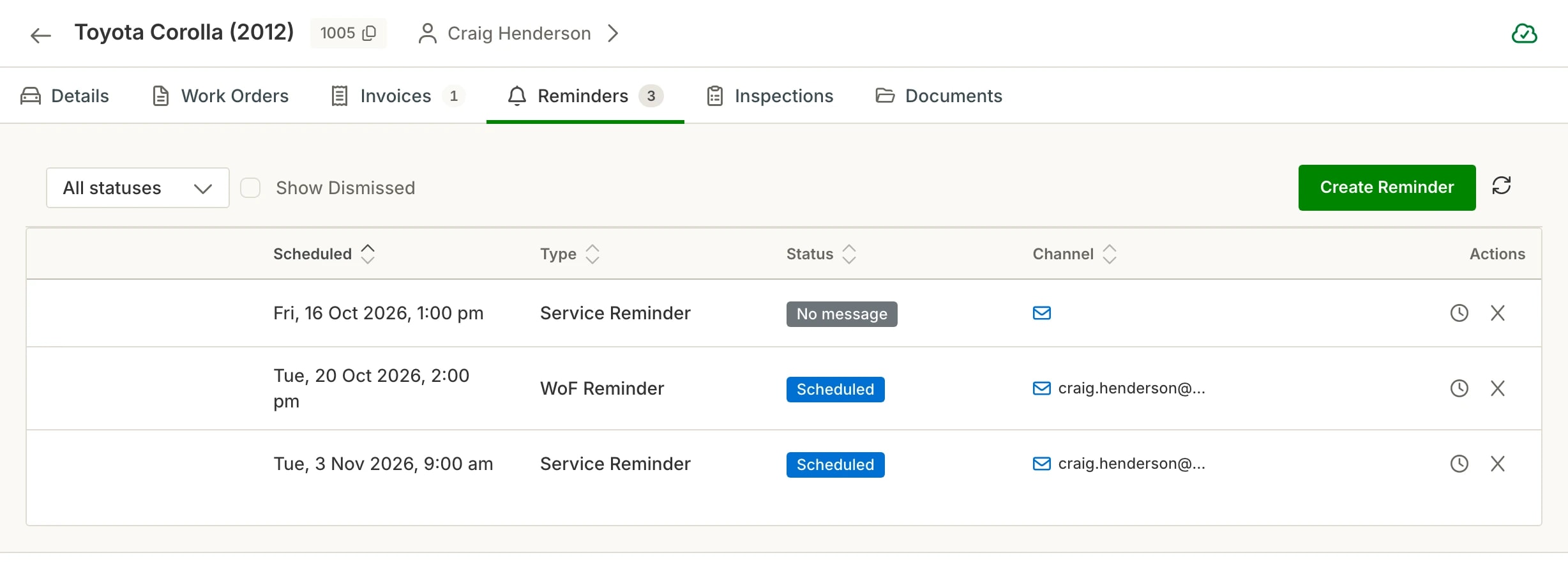
This is the problem Hoist is built around for NZ workshops: automated service and WOF reminders by SMS and email, digital job cards that keep the full vehicle history (including declined work) attached to every rego, rego lookup from official NZ vehicle records so vehicle details fill themselves in, and Xero sync so the invoicing side doesn’t eat your evenings. Declined items stay on the vehicle’s history, so the six-month declined-work list in step 3 below is a lookup, not an archaeology dig. You set the reminder rules once and they run themselves; the declined-work follow-up is a list you pull and send. Pricing’s on the pricing page if you want to run the numbers.
Start this week
The first stage lands on 1 November 2026, post-2019 vehicles going two-yearly, and the 2027 stage reaches back to 2013 registrations. Use the runway:
- Audit your reminder anchor. If everything keys off WOF expiry, start recording odometer readings and setting service-due dates on every job from Monday.
- Add one sentence to every handover. Book the next service, or at least the next reminder, before the customer leaves.
- Pull your declined-work list from the last six months and send 30-day follow-ups this week. That’s revenue already sitting in your records.
- Check your Google Business Profile and ask your next ten happy customers for a review.
- Write down your two numbers: retention rate and visits per customer, so you can tell whether any of this is working.
The workshops that hurt in 2028 will be the ones that kept running a WOF-expiry recall system after the WOF schedule stretched out from under it. The fix isn’t complicated. It just has to be set up before the gap opens, not after.
Sources: Beehive: WoF and CoF A changes to save Kiwis billions (16 Apr 2026) · NZTA Vehicle Inspection Portal: Changes to light vehicle inspections from 1 November 2026 · MTA on WOF failure rates