A workshop invoice has one job: get you paid without an argument. This page gives you a free invoice template built for NZ mechanics, every field a workshop invoice actually needs, laid out to meet IRD’s current GST record rules, with a worked dollar example so you can check your own numbers against it.
Generic invoice templates leave out the things that matter in a workshop: the rego, the odometer reading, separate parts and labour lines, sublet work. This one doesn’t.
What IRD actually requires on an invoice
Since 1 April 2023, IRD no longer requires a formal "tax invoice". The rules moved to what’s called taxable supply information: a minimum set of records you must give GST-registered customers and keep for your GST returns. You can still head your document "Tax Invoice" (most workshops do, and it’s completely fine), but the words themselves are no longer mandatory.
What is mandatory depends on the size of the job, including GST:
| Job total (incl. GST) | What’s required |
|---|---|
| $200 or less | You don’t have to give the customer anything, but your own records must show your business name, the date, a description of the work, and the amount charged. |
| $200-$1,000 | All of the above, plus your GST number and the GST amount, either GST shown separately, or a GST-inclusive total with a statement that GST is included at 15%. |
| Over $1,000 | All of the above, plus your customer’s name and at least one other identifier: such as an address, phone number, email, trading name, NZBN or website. |
Two practical takeaways for a workshop:
- Almost every job you do will clear $200, so treat the middle tier as your baseline: business name, GST number, date, description, amount, GST shown.
- A decent chunk of jobs, cambelts, clutches, engine work, fleet invoices, will clear $1,000, so just put the customer’s name and address on every invoice. It costs you nothing and you never have to think about the threshold again.
The rules are deliberately backwards-compatible: an invoice that was compliant under the old tax invoice rules is compliant now. The template below meets the over-$1,000 requirements on every invoice, which means it’s compliant at any job size.
The template, field by field
Here’s every field on the template and why it’s there.
Header
- Your trading name, address, phone, email: trading name is the legal minimum; the rest is how the customer reaches you when they want to book the next service.
- GST number: required on anything over $200. Format it as IRD issues it (e.g. 123-456-789).
- Invoice number: sequential, never reused. Xero and your accountant will both thank you.
- Invoice date: the date of the invoice or the date of supply. Pick one convention and stick to it.
Customer and vehicle
- Customer name and contact details: name plus address (or phone/email) covers the over-$1,000 rule.
- Rego, make, model, odometer: not an IRD requirement, but the single most workshop-specific part of the template. When a customer rings up three months later asking what was done to "the Hilux", the rego on the invoice settles it. The odometer reading also protects you on service-interval disputes.
Job description
- One or two plain-English lines describing the job as a whole: "60,000 km service plus front brake overhaul as authorised 14/7." This is your description of supply for IRD, and it’s also the line the customer reads first.
Parts lines
- One line per part: description, part number if you have one, quantity, unit price, line total. Itemised parts are what stop the "what am I actually paying for?" phone call.
Labour lines
- Hours × hourly rate, per task if the job had distinct stages. "Front brake overhaul: 1.5 hrs @ $95.00" reads a lot better than a bare number.
Sublet work
- Anything you farmed out, wheel alignment, radiator recore, upholstery, gets its own line, marked as sublet. You invoice the customer; the supplier’s invoice to you goes in your records.
Totals
- Subtotal (excl. GST), GST at 15%, Total (incl. GST): three lines, in that order. IRD lets you show a GST-inclusive total with a "GST included at 15%" statement instead, but showing GST as its own line is clearer, works at every job size, and matches what Xero produces.
Payment
- Payment terms: "Due on collection" or "Due within 7 days". If you don’t state a term, you’ve agreed to whenever-the-customer-feels-like-it.
- Bank account name and number: right on the invoice, so paying you is a one-step job.
Worked example
Here’s the template filled in for an ordinary front brake job, so you can sanity-check the GST maths.
TAX INVOICE Smith’s Automotive Ltd · 12 Workshop Rd, Hamilton · 07 855 0000 GST number: 123-456-789 · Invoice #1042 · Date: 27/07/2026
Customer: J. Bloggs, 45 Example St, Hamilton Vehicle: ABC123 · Toyota Hilux 2018 · 96,410 km
Job: Front brake overhaul, pads and rotors replaced, wheel alignment (sublet) as authorised.
Item Qty Unit Total Brake pads, front set (DB1234) 1 $89.50 $89.50 Brake rotors, front (DBA042) 2 $120.00 $240.00 Labour, brake overhaul, 1.5 hrs @ $95.00 1.5 $95.00 $142.50 Sublet, wheel alignment (Ace Alignments) 1 $80.00 $80.00 Subtotal (excl. GST): $552.00 GST at 15%: $82.80 Total due: $634.80
Payment due within 7 days · Smith’s Automotive Ltd · 02-0123-0456789-000
Note the direction of the maths: the unit prices are GST-exclusive, GST is 15% of the subtotal, and the two add to the total. If you start from a GST-inclusive price instead, the GST portion is the total × 3 ÷ 23, not 15% of it. Mixing those two up is the most common way workshop invoices end up a few dollars wrong.
Common mistakes that cost workshops money
GST-inclusive vs exclusive confusion. Quoting a customer "$500" meaning excl. GST, then invoicing $575, is the classic. Decide whether your quotes are inclusive or exclusive, say so on the quote, and make the invoice match.
Missing GST number. On anything over $200, no GST number means your GST-registered customers (fleet accounts especially) can’t claim the GST back cleanly, and their accountant will bounce the invoice back to you.
"Parts & labour: $850." A one-line invoice is the fastest route to a dispute. The customer can’t see what they’re paying for, so they assume the worst. Itemised parts and labour lines cost you thirty seconds and save the awkward phone call.
No payment terms or bank details. If the customer has to ring you to ask how to pay, some of them won’t.
Reused or missing invoice numbers. Gaps and duplicates are the first thing that looks wrong in a GST audit, even when nothing is.
The template is the easy part
Filling it in is the part that eats your evening. Every line on that example, the parts, the hours, the sublet, already exists on the job card. Retyping it into a Word template is the same job done twice.
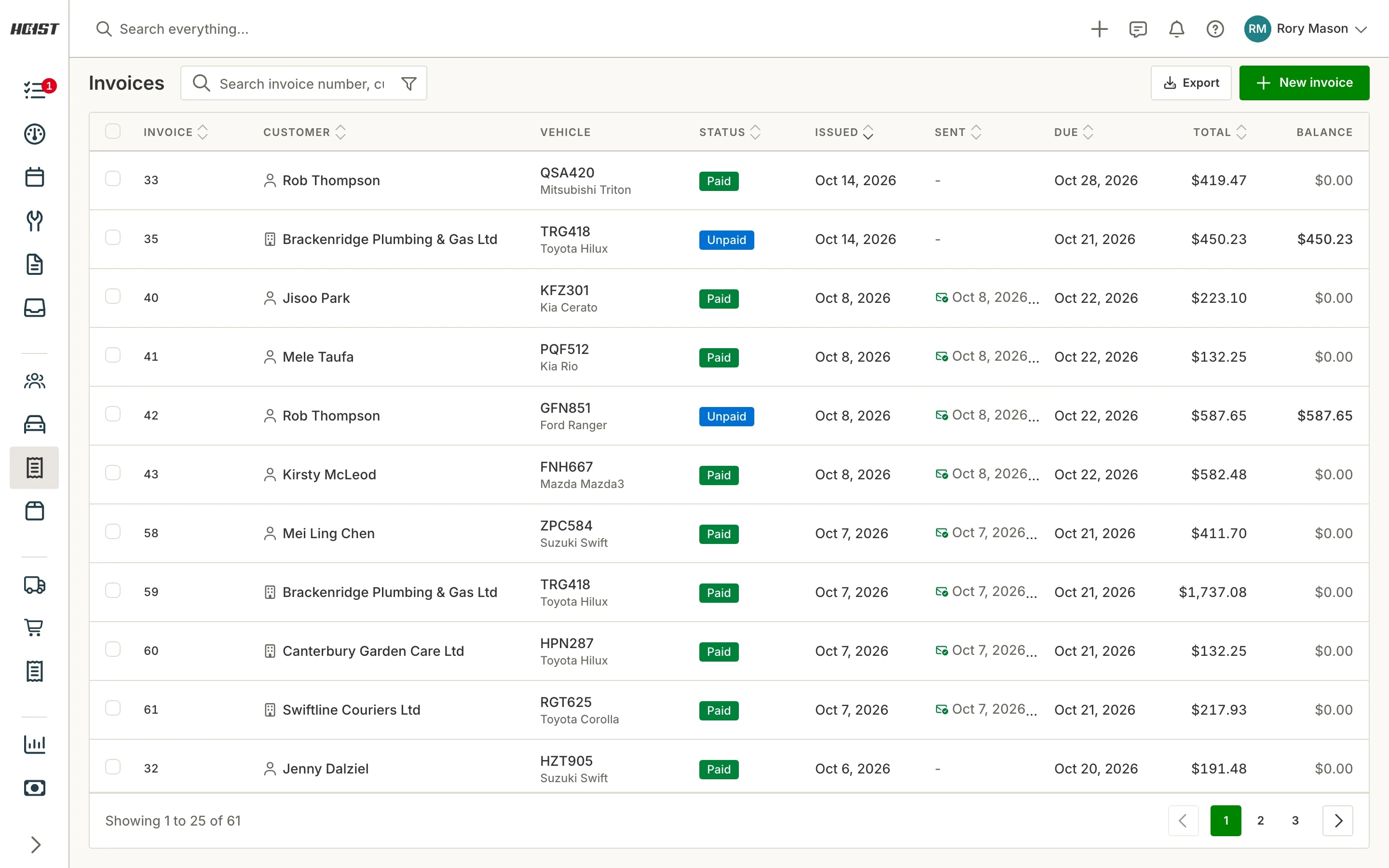
Hoist turns the job card into the invoice in one click: parts and labour lines carry across, GST is calculated correctly at 15%, and the invoice syncs straight to Xero. No retyping, no transposed digits, no Sunday-night invoice pile.
If you’d rather do the paperwork once, see how Hoist pricing works or start a free trial and run your next job through it. The invoice starts with the job card, so if you’re still on paper, our free job card template is the matching front half.
Sources: IRD: Taxable supply information for GST · IRD: How taxable supply information works · IRD: Registering for GST